THE PRESIDENT WHO WON, BUT HAS NOT YET CONVINCED
FÉLIX TSHISEKEDI’S SECOND TERM AND THE LIMITS OF POWER WITHOUT DELIVERY
FÉLIX TSHISEKEDI’S SECOND TERM AND THE LIMITS OF POWER WITHOUT DELIVERY
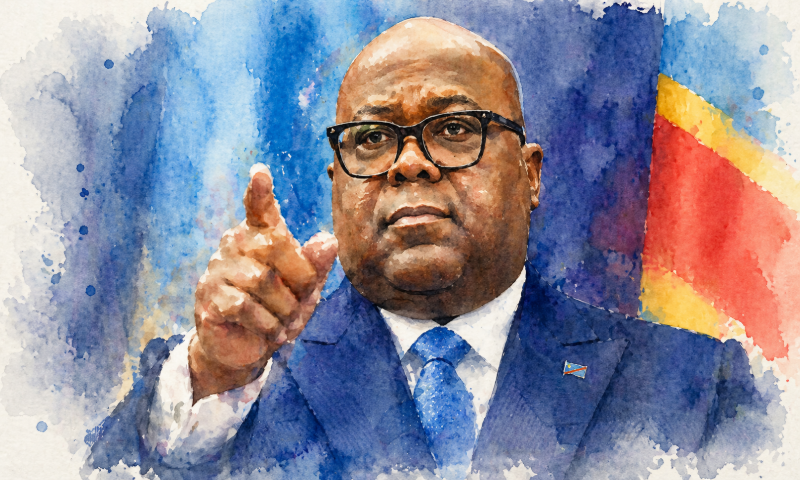
The Congolese presidency has grown stronger. The Congolese state has not yet become reliable enough for the people who need it most.
Félix Tshisekedi’s second presidency begins from a position that should, in theory, be enviable. He has secured a large official electoral victory, consolidated control over national institutions, loosened the grip of the Kabila-era networks that constrained his first term, and presides over a country whose mineral wealth has returned to the centre of global strategic competition. If politics were only arithmetic, Tshisekedi would appear comfortable. He has votes, allies, institutions, foreign suitors, and the grim political utility of facing an external adversary in the Rwanda-backed M23 rebellion. (Human Rights Watch)
And yet the second presidency does not feel comfortable. It feels brittle.
The difficulty is not that Tshisekedi lacks power. It is that the exercise of that power has not translated into a sufficiently convincing change in how the Congolese state is experienced by its citizens. The distance between what the presidency claims to do and what citizens actually live through remains stubbornly wide. In a country where the state has long been more present in rhetoric than in protection, that gap is not merely political. It is existential.
Tshisekedi has accumulated power faster than the Congolese state has accumulated capacity.
This is what defines Tshisekedi’s second term so far: not failure in the absolute sense, but a persistent failure of conversion. Policies exist. Reforms are announced. Diplomacy is active. Growth is recorded. But the transformation of these into security, predictability, dignity, learning, and trust remains incomplete. The presidency has become more assertive; the state has not become proportionally more reliable.
That distinction matters. Congolese citizens are not passive spectators of political theatre. They know the difference between a slogan and a salary, between a reform and a classroom, between a patriotic speech and an army that holds the line. They have heard presidents promise reconstruction before. Their scepticism is not cynicism. It is accumulated political experience.
Nowhere is the contradiction more visible than in eastern Congo. North Kivu, South Kivu, and Ituri are not simply conflict zones. They are the most honest mirrors of the Congolese state. They show, without ceremony, whether citizenship means protection when armed power arrives at the door.
The resurgence and expansion of M23 has exposed, again, the limits of Congolese sovereignty. Reuters reported in 2025 that UN experts said Rwanda exercised “command and control” over M23 operations, while Rwanda has denied supporting the group. The point is not secondary. External aggression matters. Rwanda’s role is real, destabilising, and central to the crisis. But external aggression has also revealed internal weakness. Kinshasa is right to denounce Kigali. It is less convincing when denunciation becomes a substitute for state capacity. (Reuters)
The human cost is devastating. OCHA reports that more than 5.35 million people were already displaced in 2025, while 26.6 million people were experiencing acute food insecurity. WFP similarly warns that 26.6 million people could face acute food insecurity by January 2026, alongside more than 5 million internally displaced people. (OCHA)
But numbers rarely capture the political meaning of fear. Reuters’ reporting from displaced communities near Goma does. Francine Nsengiyumva, a displaced widow and mother, explained why return was impossible:
“Those who took our land are still there, still killing people and terrorising.”
“We will only return when there is peace.”
— Francine Nsengiyumva, displaced resident near Goma. (Reuters)
Floride Furaha, another displaced woman, put the failure of protection even more starkly:
“Many of us have been raped. They enter the houses and rape the mother and her daughters.”
— Floride Furaha, displaced woman. (Reuters)
These are not quotations for colour. They are the moral centre of the analysis. If the question is whether Tshisekedi’s second presidency is working, the answer cannot be found only in Kinshasa’s institutional choreography. It must be asked in displacement sites, in emptied villages, in classrooms interrupted by fighting, in markets where food prices rise because roads are unsafe, and in homes where women calculate risk before movement.
To be fair, Tshisekedi did not create the eastern crisis. Its roots go back through the wars of the 1990s, the unresolved aftermath of the Rwandan genocide, failed demobilisation, land disputes, mineral economies, citizenship conflicts, armed entrepreneurship, and the chronic incapacity of the Congolese state to make its authority both legitimate and enforceable. Any analysis that treats M23 as a problem born in Tshisekedi’s office is unserious.
But any analysis that absolves the presidency because the crisis is old is equally unserious. Tshisekedi campaigned not only to inherit the state, but to govern it. The test of leadership is not whether one receives a broken machine; it is whether one repairs, replaces, or merely repaints it.
So far, there has been too much repainting.
The FARDC continues to exhibit structural weaknesses that are familiar but no less consequential: fragmented command, poor logistics, politicised appointments, unclear accountability, uneven morale, corruption in supply chains, and periodic reliance on non-state armed actors. The Guardian reported, during the M23 advance, that Congolese police officers had been seen switching sides and joining M23. That is not merely a battlefield problem. It is an institutional diagnosis. (The Guardian)
Tshisekedi’s response has been rhetorically forceful. His denunciations of Rwanda are often justified. He has also succeeded in bringing greater international attention to the crisis. This is not insignificant. For years, Congolese complaints struggled to gain traction beyond regional forums. Today, Rwanda’s role is more openly discussed, and international pressure is more visible. (Reuters)
But diplomacy cannot substitute for operational capacity. A presidency that speaks loudly about sovereignty while struggling to enforce it risks widening a credibility gap that citizens experience directly. Citizens hear the thunder; they still wait for rain.
If the East exposes the weakness of protection, the economy exposes the weakness of conversion.
On paper, the DRC has not performed badly. Growth has been comparatively strong, driven largely by mining. International financial institutions continue to engage with Kinshasa. Critical minerals have given the DRC renewed strategic relevance. The world needs Congolese copper and cobalt for its energy transition, digital infrastructure, and industrial ambitions. Congo matters again. (African Futures)
But Congolese citizens could be forgiven for asking a rude question: mattering to whom?
The Institute for Security Studies notes that high growth rates have not produced structural transformation and that the country remains dependent on extractive industries. Its analysis argues that agriculture, infrastructure, and governance must become central if growth is to become inclusive. (African Futures)
Congo is indispensable to the world’s clean-energy future, yet many Congolese still cannot rely on the lights.
This is the old Congolese paradox in updated vocabulary. The language has changed: critical minerals, green transition, strategic partnerships, global value chains. The structure remains familiar: resource wealth flows through narrow corridors while public welfare expands slowly, unevenly, and often unreliably.
For ordinary Congolese, the economy is not experienced as GDP. It is experienced as food prices, school conditions, transport costs, medical bills, informal payments, police harassment, unpaid salaries, and the exhausting daily labour of improvisation. Growth that does not alter these realities may be macroeconomically true and politically insufficient.
This is not to dismiss the importance of stability. A collapsing macroeconomic framework would worsen everything: security, salaries, education, debt, infrastructure, and public confidence. Tshisekedi’s government deserves some credit for avoiding that. But avoiding collapse is not the same as transforming lives.
Mining wealth also shapes the politics around the presidency. Katanga and Lualaba matter not because the OpEd should become a story about provincial personalities, but because mining provinces sit at the intersection of fiscal flows, elite bargaining, global capital, and national power. Figures such as Fifi Masuka illustrate this structure, but they are not the story. The story is that Tshisekedi governs through a state whose economic foundations are geographically concentrated and politically negotiated.
The presidency needs the mining heartland. The mining heartland also bargains with the presidency.
This matters because the citizen’s question is not whether the DRC is resource-rich. Everyone knows that. The citizen’s question is why resource wealth so often becomes a national myth rather than a household fact.
Free primary education remains Tshisekedi’s most socially recognisable reform. It is also the best example of his presidency’s larger pattern: an important political decision, a real social benefit, and an implementation gap large enough to become its own critique.
The reform deserves credit. In a country where school fees have long punished poor households, the abolition of primary school fees was not cosmetic. It changed household calculations. It brought millions more children into school. It asserted, at least in principle, that basic education is a public responsibility rather than a private struggle. The Institute for Security Studies notes that free primary schooling increased enrolment by more than five million students. (African Futures)
That is a major achievement. But it is also where the difficulty begins.
The very success of expanded access exposed the weakness of the system into which children were absorbed. More children entered classrooms that were already overcrowded, under-equipped, poorly supervised, and staffed by teachers whose pay, training, and motivation remained fragile. The World Bank’s 2024 education project announcement is useful because it confirms the issue in non-polemical language. Albert Zeufack, World Bank Country Director for the DRC, said:
“I was struck by the overcrowded classrooms.”
He also cited challenges around teaching materials, qualified teachers, and water and sanitation. (World Bank)
That is the education reform in miniature. The door was opened. The house was not ready.
A child sitting in an overcrowded classroom without adequate materials is counted as enrolled. But is she being educated? Governments often prefer access indicators because they are easier to count and defend. Quality is harder. It requires teacher management, supervision, payroll discipline, textbook procurement, classroom construction, water and sanitation, learning assessments, inspection systems, and the unglamorous correction of administrative leakages. There are few ribbon-cuttings for a functioning teacher payroll.
Free education therefore reveals both Tshisekedi’s ambition and his limitation. He was willing to make a large social promise. He has been less successful in building the institutional machinery required to make that promise durable and meaningful.
A slightly unkind but not inaccurate summary would be this: Tshisekedi gave many children the right to enter school, then left the school system to improvise what to do with them.
That is not failure in the simplistic sense. It is not the same as doing nothing. But it is the sort of partial success that can sour over time if expectations rise faster than delivery. Parents who once celebrated relief from fees may begin to ask why classrooms are full but learning is thin; why teachers are present but under-supported; why the state can announce education but not always provide the conditions for it.
Tshisekedi’s second term rests on a formal electoral mandate. But formal legitimacy and political trust are not the same thing.
The Carter Center’s final report on the 2023 elections noted “significant deviations from established legal processes” in tabulation and stated that the failure to publish lower-level election results reduced transparency. Human Rights Watch also described the election as highly contested, marked by logistical problems, irregularities, violence, and opposition rejection of the results. (Carter Centre)
This does not erase Tshisekedi’s legal presidency. But it weakens the reservoir of trust available to him. A president emerging from a contested process must govern with particular care. He must widen confidence, not narrow it. He must make institutions look more independent, not more obedient. He must avoid moves that make citizens suspect that victory was not enough.
Here, the constitutional debate has been especially damaging.
In October 2024, Tshisekedi floated constitutional revision, including discussion around term limits. Human Rights Watch noted that he had previously pledged to “scrupulously respect constitutional obligations.” Opposition leaders interpreted the debate as a possible third-term manoeuvre. Claudel Lubaya told Reuters:
“By changing the rules of the game to stay in power, the current regime is only seeking to prolong its political survival.” (Human Rights Watch)
The presidency may argue that constitutional reform is necessary. In principle, that is not absurd. Constitutions are not sacred relics. They can require revision. But politics is not conducted in principle; it is conducted in context. In a second term, in a low-trust environment, amid war and poverty, any move towards constitutional revision will be read through the lens of term limits.
That may be unfair in legal theory. It is entirely predictable in political practice.
In Congo, constitutional reform during a second term sounds less like institutional engineering than the opening bars of a familiar song.
The problem is not only that constitutional revision may threaten alternation. It is that the debate consumes trust the presidency cannot afford to waste. Every hour spent reassuring citizens that reform is not a third-term manoeuvre is an hour not spent convincing them that the state can protect Goma, improve schools, pay soldiers, or reduce the costs of daily life.
Tshisekedi’s second term has strengthened the presidency. It has not yet strengthened the state enough.
That distinction is crucial. A stronger presidency can dominate parliament, shape appointments, discipline coalition partners, marginalise rivals, and control the narrative. A stronger state can protect citizens, deliver services, enforce rules impartially, collect taxes fairly, manage resources transparently, and survive beyond the preferences of one man.
Congo needs the second. Tshisekedi has made more progress on the first.
His defenders would argue that centralisation was necessary. The first term was constrained by Kabila-era networks, institutional sabotage, elite fragmentation, and an inherited administration that often served interests other than the elected president. There is truth in this. No serious observer can pretend that Tshisekedi began in 2019 with a clean institutional slate.
But the second term raises a different concern. What began as emancipation from inherited constraints risks becoming a system of loyalty filtration. Reshuffles, dismissals, prosecutions, and administrative changes may each have their justification. Some officials are corrupt. Some commanders are incompetent. Some political actors are opportunistic. A president at war cannot be expected to preserve every rival in amber for the sake of pluralism.
Yet patterns matter. When too many changes appear to reward loyalty over competence, public interpretation shifts. Citizens and elites begin to see the state not as being reformed, but as being sorted. The question becomes not “Who can deliver?” but “Who is trusted by the centre?”
In a country where institutions are already weak, this is dangerous. Loyalty may protect the president. Competence protects the country.
The parliamentary machinery around Tshisekedi illustrates this wider system. Aimé Boji Sangara Bamanyirue should not be over-personalised in the analysis. He is not the main character; Tshisekedi is. But his elevation to the National Assembly presidency matters as part of a broader architecture of institutional insulation. Parliament is not only a law-making body. In the second term, it functions increasingly as a shock absorber around the presidency: managing alliances, containing dissent, and translating presidential priorities into institutional form.
This is normal up to a point. Presidents need parliamentary majorities. But when legislative loyalty becomes too complete, accountability suffers. A parliament that only amplifies the presidency becomes less a chamber than a sound system.
The question of “tribalism” in Tshisekedi’s presidency must be handled carefully. It is too easy, and often dangerous, to reduce Congolese politics to ethnicity. The DRC is governed through overlapping systems: region, party, family, church, business, military networks, international alliances, mining interests, provincial bargains, and personal loyalty. Ethnicity is one language of power, not the whole dictionary.
Yet it would be naïve to pretend it does not matter.
Under Tshisekedi, accusations of Kasaïan preference have circulated widely in political discourse. Some are opportunistic. Some are exaggerated. Some reflect genuine anxiety over access to state resources. The analytical point is not that ethnicity explains everything. It is that weak institutions allow everything to be explained ethnically.
In a trusted bureaucracy, an official can be judged by competence. In a distrusted bureaucracy, he becomes evidence. In a trusted army, a reshuffle can be read as reform. In a distrusted army, it becomes a purge. In a trusted parliament, majority discipline is politics. In a distrusted parliament, it becomes capture.
Tshisekedi did not invent this logic. But he is now judged by whether he reduces or reproduces it.
The East adds a more dangerous layer. The M23 conflict intersects with questions of Tutsi identity, Congolese nationality, land rights, refugee histories, and Rwanda’s regional ambitions. A responsible Congolese presidency must denounce Rwanda’s role and armed rebellion without allowing anti-Rwandan sentiment to slide into suspicion of Congolese citizens associated, rightly or wrongly, with Rwandophone identity.
This is not a matter of politeness. It is conflict prevention. Nationalist rhetoric can unify, but it can also license. The state must defend sovereignty while protecting citizenship. If it fails, the war will not only be fought over territory; it will be fought through identity.
A strong state can distinguish between a foreign-backed armed group and a citizen community. A weak state lets fear do the sorting. Fear is a poor administrator.
The most important shift in assessing Tshisekedi’s second term is to stop asking only what the president has done and ask what citizens can now do differently because of it.
Can displaced families return safely? Too often, no.
Can parents send children to primary school without fees? More often, yes.
Can they expect those children to learn in acceptable conditions? Too often, not yet.
Can citizens trust elections to reflect rules rather than arrangements? Many do not.
Can they rely on economic growth to improve daily life? Only unevenly.
Can they expect institutions to check the presidency? Less than they should.
Can they speak politically without fearing administrative consequence? That question is increasingly uncomfortable.
This is the citizen’s balance sheet. It is less flattering than the presidential one.
Tshisekedi’s second presidency is therefore not best described as simple failure. It is a presidency of partial achievements trapped inside a deeper failure of conversion. The country is more visible internationally. The presidency is more powerful domestically. Some reforms are real. Some diplomatic gains are meaningful. Some macroeconomic indicators are positive. But citizen experience remains too often marked by insecurity, poverty, mistrust, and institutional improvisation.
The tragedy is that Tshisekedi understands parts of the problem. He knows Congo must be treated as a serious strategic actor. He knows Rwanda’s role in the East must be confronted. He knows education matters. He knows the state cannot remain indefinitely hostage to Kabila-era arrangements. He knows that Congo’s minerals give it leverage.
These are not small insights.
But knowing is not governing. Governing requires the conversion of insight into systems, and systems into predictable citizen experience. This is where the presidency has underperformed.
The second term still has time. But time is not neutral. In the East, it is measured in displacement. In classrooms, in lost learning. In politics, in shrinking trust. In constitutional debates, in suspicion. In households, in prices and unpaid bills.
For citizens, the presidential calendar is not five years long. It is renewed every morning.
Tshisekedi’s central problem is not that he lacks a mandate. It is that he has not yet made his mandate feel like protection. He has not yet made growth feel like welfare. He has not yet made free education feel like quality schooling. He has not yet made institutional control feel like state competence. He has not yet made sovereignty feel like safety.
That is why he can be electorally victorious and politically unconvinced; stronger and more exposed; internationally visible and domestically doubted.
The presidency has learned to command attention.
The state still has to earn trust.
And in the DRC, that difference is not a footnote. It is the republic.
La présidence congolaise s’est renforcée. L’État congolais n’est pas encore devenu suffisamment fiable pour ceux qui en ont le plus besoin.
Le second mandat de Félix Tshisekedi commence dans une position qui devrait, en théorie, être enviable. Il a remporté une large victoire électorale officielle, consolidé son contrôle sur les institutions nationales, desserré l’emprise des réseaux hérités de l’ère Kabila qui limitaient son premier mandat, et dirige un pays dont les richesses minières sont revenues au centre de la compétition stratégique mondiale. Si la politique n’était qu’une question d’arithmétique, Tshisekedi semblerait à l’aise. Il dispose de voix, d’alliés, d’institutions, de partenaires étrangers, ainsi que de l’utilité politique sombre que représente la présence d’un adversaire externe dans la rébellion du M23 soutenue par le Rwanda.
Et pourtant, ce second mandat ne donne pas une impression de confort. Il donne une impression de fragilité.
La difficulté n’est pas que Tshisekedi manque de pouvoir. Elle est que l’exercice de ce pouvoir ne s’est pas traduit par un changement suffisamment convaincant dans la manière dont l’État congolais est vécu par ses citoyens. La distance entre ce que la présidence affirme faire et ce que les citoyens vivent réellement reste obstinément large. Dans un pays où l’État a longtemps été plus présent dans la rhétorique que dans la protection, cet écart n’est pas simplement politique. Il est existentiel.
Tshisekedi a accumulé du pouvoir plus rapidement que l’État congolais n’a accumulé de capacité.
C’est ce qui définit ce second mandat : non pas un échec au sens absolu, mais un échec de conversion persistant. Les politiques existent. Les réformes sont annoncées. La diplomatie est active. La croissance est enregistrée. Mais la transformation de ces éléments en sécurité, en prévisibilité, en dignité, en apprentissage et en confiance reste incomplète. La présidence s’est affirmée ; l’État ne s’est pas renforcé dans les mêmes proportions.
Cette distinction est essentielle. Les citoyens congolais ne sont pas des spectateurs passifs du théâtre politique. Ils savent faire la différence entre un slogan et un salaire, entre une réforme et une salle de classe, entre un discours patriotique et une armée qui tient une ligne. Ils ont déjà entendu des promesses de reconstruction. Leur scepticisme n’est pas du cynisme. C’est de l’expérience politique accumulée.
Nulle part cette contradiction n’est plus visible que dans l’Est du Congo. Le Nord-Kivu, le Sud-Kivu et l’Ituri ne sont pas simplement des zones de conflit. Ce sont les miroirs les plus honnêtes de l’État congolais. Ils montrent, sans mise en scène, si la citoyenneté signifie protection lorsque la violence armée arrive.
La résurgence et l’expansion du M23 ont, une fois de plus, exposé les limites de la souveraineté congolaise. Reuters a rapporté en 2025 que des experts des Nations Unies affirmaient que le Rwanda exerçait un « commandement et contrôle » sur les opérations du M23, tandis que Kigali nie soutenir ce groupe.
La question n’est pas secondaire. L’agression extérieure est réelle. Le rôle du Rwanda est réel et déstabilisant. Mais cette agression a aussi révélé une faiblesse interne. Kinshasa a raison de dénoncer Kigali. Elle est moins convaincante lorsque la dénonciation remplace la capacité de l’État.
Le coût humain est dévastateur. OCHA rapporte que plus de 5,35 millions de personnes étaient déplacées en 2025, tandis que 26,6 millions faisaient face à une insécurité alimentaire aiguë.
Mais les chiffres ne capturent pas le sens politique de la peur. Les témoignages, eux, le font.
« Ceux qui ont pris nos terres sont toujours là, ils continuent de tuer et de terroriser. »
« Nous ne rentrerons que lorsqu’il y aura la paix. »
« Beaucoup d’entre nous ont été violées. Ils entrent dans les maisons et violent la mère et ses filles. »
Ces citations ne sont pas décoratives. Elles sont le cœur moral de l’analyse.
Dans l’Est, la question n’est pas géopolitique. Elle est immédiate : l’État protège-t-il ?
Trop souvent, la réponse est non.
Tshisekedi n’a pas créé cette crise. Mais il est désormais jugé sur sa capacité à y répondre. Et jusqu’à présent, la perception dominante est celle d’un État qui gère la crise plus qu’il ne la transforme.
L’armée congolaise (FARDC) continue de présenter des faiblesses structurelles connues : fragmentation du commandement, logistique insuffisante, nominations politisées, responsabilité limitée, moral inégal, corruption dans les chaînes d’approvisionnement, et recours à des groupes armés non étatiques.
Le Guardian a même rapporté que des policiers congolais avaient été vus changeant de camp pour rejoindre le M23.
Ce n’est pas seulement un problème militaire. C’est un diagnostic institutionnel.
Tshisekedi a répondu avec force dans ses discours. Ses dénonciations du Rwanda sont souvent justifiées. Il a également réussi à attirer davantage d’attention internationale sur la crise.
Mais la diplomatie ne remplace pas la capacité opérationnelle.
Un président qui parle fort de souveraineté mais peine à l’imposer risque d’élargir un déficit de crédibilité que les citoyens ressentent directement.
Les citoyens entendent le tonnerre. Ils attendent encore la pluie.
Si l’Est révèle la faiblesse de la protection, l’économie révèle celle de la conversion.
Sur le papier, la RDC ne s’en sort pas mal. La croissance est relativement forte, tirée par le secteur minier. Les institutions financières internationales restent engagées. Les minerais stratégiques donnent au pays une importance renouvelée.
Mais les citoyens pourraient poser une question simple : important pour qui ?
Le Congo est indispensable à la transition énergétique mondiale, mais de nombreux Congolais n’ont toujours pas accès à une électricité fiable.
La croissance existe. Mais elle ne se traduit pas suffisamment dans la vie quotidienne.
Pour les citoyens, l’économie n’est pas une statistique. C’est :
La richesse minière circule. Les services publics beaucoup moins.
La gratuité de l’enseignement primaire reste la réforme la plus visible de Tshisekedi.
Elle a permis à des millions d’enfants d’aller à l’école. C’est un progrès réel.
Mais elle a aussi mis à nu les faiblesses du système.
Les classes sont surchargées. Les enseignants insuffisamment soutenus. Les infrastructures inadéquates.
La porte a été ouverte. La maison n’était pas prête.
Un enfant inscrit n’est pas nécessairement un enfant qui apprend.
Le second mandat repose sur un mandat électoral formel. Mais la légitimité formelle et la confiance politique ne sont pas la même chose.
Les critiques sur le processus électoral et les débats autour de la révision constitutionnelle alimentent une méfiance persistante.
Au Congo, une réforme constitutionnelle en second mandat ressemble moins à un ajustement institutionnel qu’au début d’un scénario déjà connu.
Le problème n’est pas seulement juridique. Il est politique.
Tshisekedi a renforcé la présidence. Mais cela ne signifie pas qu’il a renforcé l’État.
Un président fort peut contrôler.
Un État fort peut protéger.
La différence est décisive.
La meilleure manière d’évaluer ce second mandat est simple :
Qu’est-ce qui a changé pour les citoyens ?
Peuvent-ils vivre en sécurité ?
Pas toujours.
Peuvent-ils envoyer leurs enfants à l’école ?
Plus qu’avant.
Apprennent-ils dans de bonnes conditions ?
Pas suffisamment.
Peuvent-ils faire confiance aux institutions ?
Pas vraiment.
La présidence est plus forte.
La vie quotidienne reste incertaine.
Le second mandat de Tshisekedi n’est pas un échec total. C’est une accumulation de progrès partiels enfermés dans une transformation incomplète.
Le pays est plus visible.
Le pouvoir est plus centralisé.
Certaines réformes sont réelles.
Mais l’expérience des citoyens reste marquée par l’insécurité, la pauvreté et le manque de confiance.
Tshisekedi comprend les enjeux.
Mais comprendre ne suffit pas.
Gouverner, c’est transformer.
Et aujourd’hui, le Congo reste un pays où la présidence capte l’attention…
…mais où l’État doit encore gagner la confiance.
Et dans la RDC, cette différence n’est pas un détail.
C’est l’essentiel.
ENDNOTES / SOURCES
[1] Human Rights Watch. (2024). A human rights agenda for the Democratic Republic of Congo. (Human Rights Watch)
[2] Reuters. (2024). Congo President Tshisekedi draws criticism over constitutional reform plans. (Reuters)
[3] Reuters. (2025). Congo’s displaced fear violence, rape if they return home. (Reuters)
[4] OCHA. (2025). Democratic Republic of the Congo humanitarian overview. (OCHA)
[5] World Food Programme. (2026). Democratic Republic of the Congo emergency page. (World Food Programme)
[6] The Guardian. (2025). M23 rebels push south from Goma as DRC leader calls for military recruits. (The Guardian)
[7] Institute for Security Studies. (2024). Can Tshisekedi’s second term deliver inclusive growth for DRC? (African Futures)
[8] World Bank. (2024). Democratic Republic of Congo: Expanding and equipping primary school classrooms for better learning outcomes. (World Bank)
[9] Carter Center. (2024). General elections in the Democratic Republic of the Congo: Final report. (Carter Centre)
[10] Human Rights Watch. (2024). DR Congo: President suggests changes to term limits. (Human Rights Watch)
[11] Reuters / The Straits Times republication. (2024). Claudel Lubaya quoted on constitutional reform. (The Straits Times)
Johan G.L. Verheyden is a social scientist, senior researcher, and research director at Aries Consult. With over three decades of experience in Africa and other fragile and post-conflict settings, his work focuses on political economy, conflict, governance, and international intervention. He specialises in mixed-methods research and critical analysis of global institutions and power structures. A Belgian, he is based in Nairobi, Kenya.
Comments
No comments yet.
Leave a comment